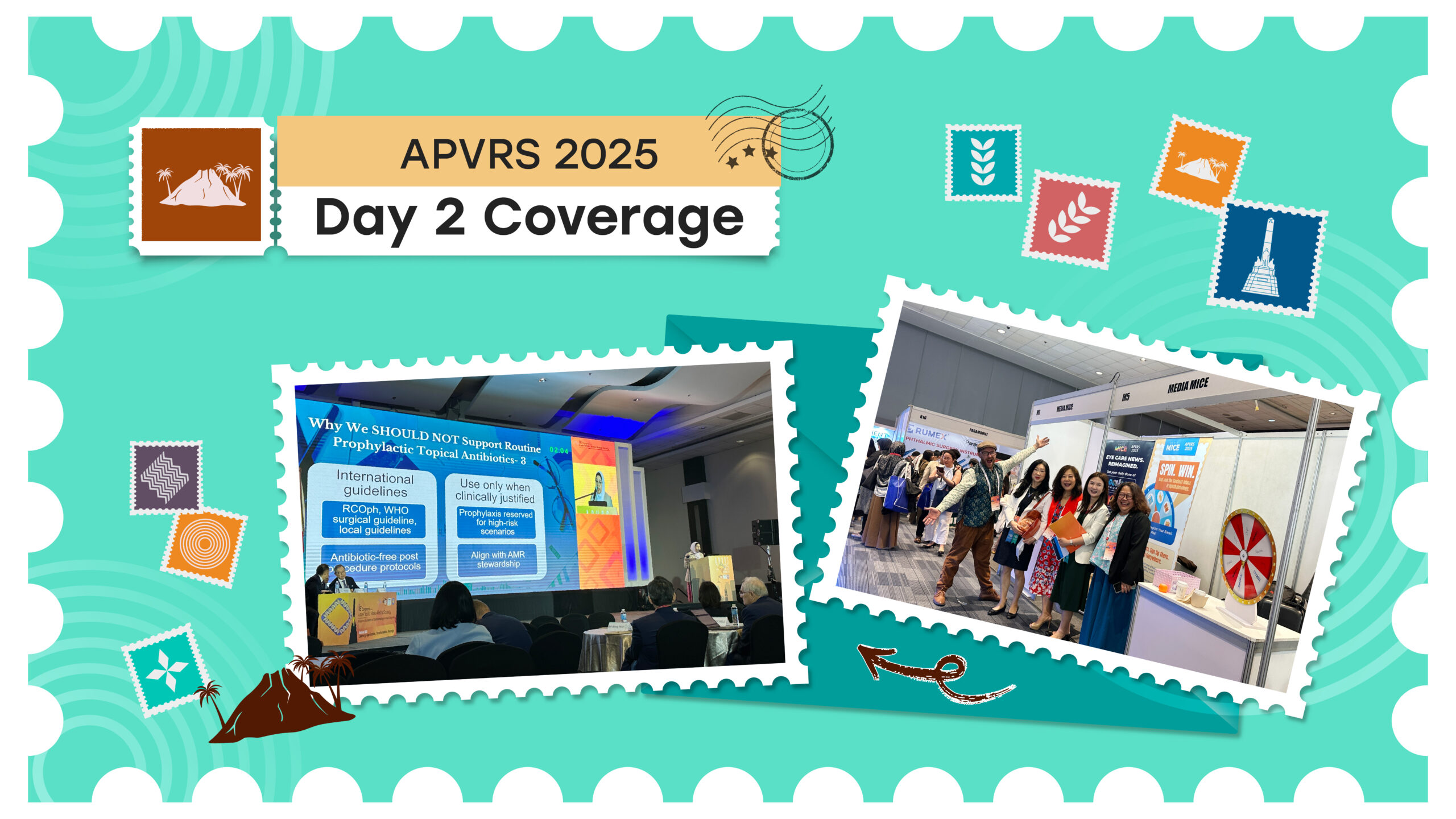
From last-mile systems to last-resort surgeries, Day 2 in Manila tackled what happens when real-world retina refuses to behave.
Manila’s sun rose early on Day 2 of the 18th Congress of the Asia-Pacific Vitreo-Retina Society (APVRS 2025) and so did the clinical heat. In rooms packed tighter than a morning MRT, today’s sessions dialed in on what happens when theory meets logistics, when guidelines meet real patients, and when retina, glaucoma and public health try to share the same roadmap.
At the Mall of Asia (MOA) Complex, the RETINA 360 theme earned its name with sessions that refused to stay in a single lane. Where Day 1 was Manila’s warm handshake, Day 2 was the full-body checkup. Retina met glaucoma. Retina met policy. Retina met its own internal arguments, in front of an audience that clearly enjoyed watching the field debate itself with data and a little bite.
Session highlights
First came Glaucoma 2, where Filippino glaucoma specialists unpacked what happens when retinal disease and optic nerve risk share the same cramped apartment. Dr. Maria De Guzman (Philippines) summed up the diagnostic mess in one line: “The problem when we have glaucoma and retinal disease…is that there’s an overlap in the structures that are damaged and the functional manifestations of that damage.”
She also stressed that unlike primary open-angle glaucoma, secondary glaucoma linked to retinal disease may be preventable or halted when the specific mechanism of intraocular pressure (IOP) elevation is identified and addressed early, rather than managed as untreatable progression. The practical theme was earlier coordination, smarter baselines and fewer assumptions that the usual glaucoma rules will behave politely in these eyes.
READ MORE: When Retina Meets Glaucoma at APVRS 2025
At The Last Miles of Retinal Care, speakers treated access, follow-up and financing as clinical variables, not background noise. Prof. Taraprasad Das (India) defined the job as “the process of extending comprehensive and quality eye care into the most peripheral populations, ensuring equitable access regardless of geography, poverty and social barriers,” while Dr. Padmaja Kumari Rani (India) argued that readiness only matters if it turns into follow-through.
Dr. Rani detailed India’s four-pillar diabetic retinopathy (DR) care model of early detection through awareness, sustainability, continuous training with task-shifting and capacity building, which doubled screening uptake when programs moved from fee-based to free access.
The session also carried Manila’s most local note of diskarte through Dr. Jennifer Joy Santos-Rayos’s (Philippines) programs that hardwire screening and follow-up into the system, not just the slides.
READ MORE: The Last Miles of Retinal Care at APVRS 2025 Put Systems on the Retina Map
Finally, Challenges and Controversies in Medical Retina let the field do what it secretly loves, which is to argue the fine print in public. While Prof. Timothy Lai (Hong Kong) cited EVEREST II data showing 69% polyp closure with combination therapy yielded three lines of vision gain,* Dr. Kelvin Teo (Singapore) countered that vision improvement correlates with disease activity markers like fluid resolution, not polyp closure itself, with comparable long-term visual outcomes regardless of polyp status.
The session ran through antibiotic habits, durability tradeoffs, adherence and stopping rules, then ended where clinics often end too, with pressure and fluid and no single “right” answer that survives every optical coherence tomography (OCT).
READ MORE: Retina on the Ropes: Tackling the Toughest Debates in Medical Retina at APVRS 2025
On the trade floor
Day 2 didn’t have a single snack mascot as iconic as yesterday’s taho, but the exhibit hall still had plenty of pull. Between the big sponsor booths and the steady hum of demos, it felt a bit like Manila traffic in miniature (minus the horn section). Everyone moving, everyone swapping notes and hunting for the fastest route to “works in real life.”
A smart, industry-adjacent detour was the surgical retina poster discussion, which kept things satisfyingly practical, from fluidics in triamcinolone-assisted vitrectomy across small-gauge cutters and cutting speeds, to OCT-based staging systems aiming to make macula-off rhegmatogenous retinal detachment (RRD) and epiretinal membrane (ERM) outcomes less of a coin toss. It was a nice reminder that innovation isn’t always a splashy molecule. Sometimes it’s the fine print that quietly upgrades the whole workflow, jeepney-style: take what you’ve got, tune it and make it get patients where they need to go.
You could also spot crisp barong tagalog details in the crowd, light and formal, and the way senior speakers were received had a subtle mano po energy. Respect for experience and a sense that tomorrow’s retina is being built on yesterday’s foundations.
From IOP to outposts, Manila kept it 360
As the day wound down and delegates spilled into the humid Manila evening, weaving past jeepneys, karaoke bars and the glow of Christmas lights, the science kept bumping into real-world constraints.
RETINA 360 came full circle today in the pressure, policy and daily compromises between ideal care and available care. Retina took the front seat, but systems drove the conversation. And in this city of color and contradiction, it was a fitting reminder that the last mile isn’t the end. It’s the part of the journey that matters most.
If Day 3 delivers on today’s momentum, it won’t just close the meeting. It’ll send people home with sharper workflows and fewer blind spots.
*Koh A, Lai TYY, Takahashi K, et al. Efficacy and safety of ranibizumab with or without verteporfin photodynamic therapy for polypoidal choroidal vasculopathy: A randomized clinical trial. JAMA Ophthalmol. 2017;135(11):1206-1213.
Editor’s Note: This content is intended exclusively for healthcare professionals. It is not intended for the general public. Products or therapies discussed may not be registered or approved in all jurisdictions, including Singapore. Reporting for this story took place during the 18th Congress of the Asia-Pacific Vitreo-Retina Society (APVRS 2025) from 12-14 December in Manila, Philippines.