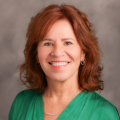
Laser-focused on what works and fearless in challenging trends, Dr. María Berrocal blends wisdom, world-class science and a Caribbean spirit to keep retina care grounded and always moving forward.
From San Juan to international symposium spotlights, Dr. María Berrocal (Puerto Rico) embodies not just excellence in retina, but resilience, gratitude and grace. Her journey is a testament to wisdom passed down, shared generously and carried forward…one act of kindness at a time.
Ophthalmology may not technically run in her DNA, but inspiration certainly does. Her father, the late Dr. José Berrocal, was the first retina specialist in Puerto Rico and a pioneer throughout the Caribbean.
“He performed the first scleral buckle in the Dominican Republic,” she recalled, still full of admiration. “Teaching was central to his life. He chaired the Department of Ophthalmology in Puerto Rico and devoted his life to his patients and students.”
A legacy of vision
Growing up surrounded by rounds, conferences and retina legends from around the world, Dr. Berrocal absorbed excellence as a way of life.
“I worked in his office, rounded with him on weekends and met retina specialists from all over the world. His passion for ophthalmology and teaching shaped my values,” she said. “I’ve tried to emulate that same dedication, and I’m proud that my children have followed in his footsteps.”
Dr. Berrocal’s medical path led her through the University of Illinois, the University of Puerto Rico (where she earned the Best Surgeon Award) and vitreoretinal fellowships at both Cornell and Bascom Palmer Eye Institute. A brilliant career anywhere was hers for the taking, but her compass pointed home.
“My father and I were very close, and I wanted to work alongside him,” she recalled. “I also felt a strong commitment to serve the people of Puerto Rico, where diabetes and its complications are so prevalent. I knew I could make the greatest impact there.”
That decision anchored her life’s mission: to honor a legacy through innovation, compassion and the mentorship of generations to come.
READ MORE: Seeing is Believing?
The many hats of a single mission
Today, as CEO of Drs. Berrocal and Associates in San Juan and an Associate Professor at the University of Puerto Rico, Dr. Berrocal simultaneously leads, teaches, performs surgery, researches and advocates. But don’t call it “balancing.”
“I don’t like the word ‘balance,’” she said with a smile. “I don’t think of my work as something to balance. I simply love what I do. Teaching, traveling, seeing patients and performing surgery are part of my life’s mission.”
That unity carries into her home as well.
Dr. Berrocal’s husband, an oncologist, shares her devotion to patients. Her daughter helps run the practice as COO. And her son—soon to return after completing his retina fellowship—will extend the family tradition. “Our shared purpose makes everything flow naturally,” she said. “It’s not work-life balance; it’s one life, lived with purpose.”
Research with a real-world pulse
With more than 180 scientific publications, Dr. Berrocal’s research is prolific yet deeply grounded in patient reality.
“Through PACORES, the Pan-American Collaborative Retina Study Group, we’ve conducted multicenter studies across Latin America,” she explained. “This is essential real-world research that reflects our region’s genetic, ethnic and environmental diversity.”
Dr. Berrocal’s focus on diabetic retinopathy, one of the leading causes of blindness worldwide, reveals both scientific precision and social awareness.
“The diabetes explosion stems largely from obesity and poor nutrition,” she explained. “GLP-1 inhibitors and awareness of ultra-processed foods may help address the root causes, but poverty and limited access to care remain systemic issues that require policy solutions.”
Dr. Berrocal sees prevention leading the future: long-acting drugs, gene therapy and multi-target approaches that intervene earlier and more effectively.
“A patient who lives 12 hours from an ophthalmologist needs a different strategy than one with immediate access to care,” she said. “We must tailor treatments to each patient’s reality, otherwise, the best science will still fail in the real world.”
READ MORE: When the Pendulum Swings
Keep calm and don’t toss the buckle
At EURETINA 2025, Dr. Berrocal delivered the prestigious Ingrid Kreissig Award Lecture. Titled Don’t Throw Away Wisdom, it served as both a warning and a wake-up call.
“We often embrace new treatments as ‘modern’ without carefully examining the evidence,” she explained. “Minimal scleral buckling—segmental or radial, no drainage—for phakic rhegmatogenous detachments provides better visual outcomes and fewer complications than vitrectomy. Yet many have abandoned it.”
Her perspective extends to proliferative diabetic retinopathy, where she reinforces that pan-retinal photocoagulation remains the gold standard.
“The treatment burden and cost are unsustainable,” she cautioned. “Patients lost to follow-up after anti-VEGF monotherapy often suffer devastating complications that could have been avoided with laser treatment. This is a global problem, as injections are mistakenly viewed as simpler alternatives.”
Her advocacy is steadfast: evidence first, marketing never. She also pointed out that higher mortality signals in diabetics treated with monthly anti-VEGF reinforce the need to scrutinize real-world outcomes.
Among Dr. Berrocal’s many international accolades—including the American Academy of Ophthalmology Lifetime Achievement Award, the American Society of Retinal Specialists Founders Award and the Stanley Chang Lectureship—one holds special meaning: the Kreissig Award Lecture.
“I trained with Harvey Lincoff, who pioneered minimal surgery with Ingrid Kreissig, a true role model and one of the first women to chair an ophthalmology department,” she shared. “Coming from a small Caribbean island, as a Hispanic woman, to be recognized by the European retina community for continuing that legacy was profoundly humbling.”
READ MORE: The DOG Experience
Empowerment with a gentle hand
As one of the most respected female leaders in retina, Dr. Berrocal continues to mentor and inspire young women in ophthalmology worldwide. Her message is one of empowerment rooted in grace. A reminder that leadership doesn’t require imitation, but authenticity.
She remembered what it felt like to be one of few women in a male-dominated specialty. “Be yourself. Don’t try to be like men,” she said. “Women bring unique strengths to medicine: empathy, listening and a holistic concern for patients’ lives.”
Dr. Berrocal noted that studies show better outcomes for patients of female physicians, evidence that communication and understanding are powerful tools, not soft skills.
“Overcome imposter syndrome,” she advised. “Women who reach this level have often had to be more qualified than their male peers. Own it. Be proud, confident and kind.”
Her service extends far beyond the clinic, from scholarships for cancer survivors to educational support programs and contributions to drug rehabilitation initiatives in San Juan.
Privilege, she said, demands responsibility. “Being born into a supportive family, in a society that values education, is an immense privilege,” she noted. “I remind my children to stay humble and grateful, because many with equal or greater talent never get the same chance.”
READ MORE: More Than One-third of Older Asian Adults Have Undiagnosed Eye Disease, JAMA Study Shows
Seeing tomorrow, clearly
Looking ahead, Dr. Berrocal envisions a retina field transformed by more targeted, longer-acting therapies and the expanding use of gene therapy. Surgically, she anticipates continued evolution with smaller-gauge instrumentation and digital visualization.
In the coming years, she hopes to contribute more to global training efforts.
“My experience with ORBIS in Bangladesh was one of the most fulfilling of my life—teaching local retina specialists, many of them women, and adapting therapies to their realities was deeply inspiring,” she recalled. “True progress means understanding local needs, not exporting one-size-fits-all solutions. I hope to continue sharing knowledge with colleagues working under challenging conditions.”
Her greatest legacy, however, remains rooted close to home.
“I’m grateful every day for my health after surviving cancer, for my family and for the privilege of doing what I love,” she said. “My son will soon join me in practice. My daughter continues to manage the clinic. And my sister—also a retina specialist—practices in Miami. Our family’s life work continues, and hopefully, we will make life better for others.”
Editor’s Note: This content is intended exclusively for healthcare professionals. It is not intended for the general public. Products or therapies discussed may not be registered or approved in all jurisdictions, including Singapore. A version of this article was first published in PIE Issue 37.