
Science, culture and retina royalty set a high bar as APVRS 2025 bursts into Manila.
The 18th Congress of the Asia-Pacific Vitreo-Retina Society (APVRS 2025) officially opened in Manila, with an extravagant ceremony that featured welcoming remarks from Congress President Dr. Harvey Uy (Philippines), President Prof. Hiroko Terasaki (Japan) and Secretary General Prof. Andrew Chan (Australia), alongside a vibrant showcase of Filipino cultural dances that highlighted the host country’s heritage.
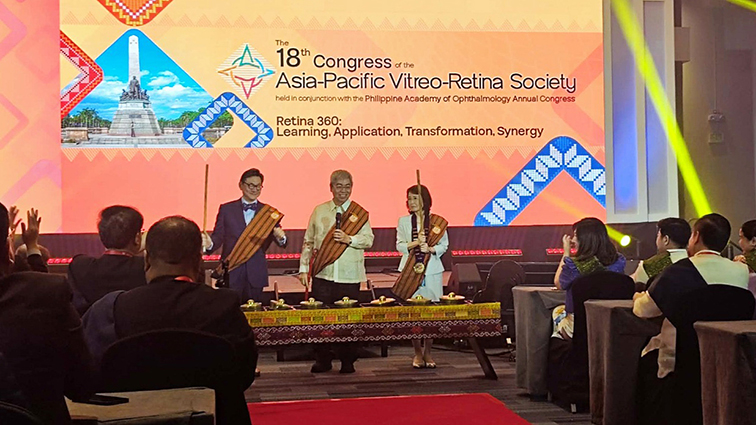
Two major scientific honors anchored the ceremony: the Tano Lecture Award, received and delivered by Prof. Rajvardhan Azad (India), and the International Award Lecture presented by Prof. SriniVas Sadda (USA), setting a strong academic tone for APVRS 2025.
Opening remarks
Speaking on behalf of the organizing committee Dr. Uy welcomed the international audience, noting the importance and scale of the congress, saying, “We are very honored and thrilled to have more than 3,000 attendees this year.”

Prof. Terakasi emphasized the collective spirit of the society, stating, “The APVRS Manila Congress has grown into a truly united dynamic community dedicated to advancing our understanding and treatment of retinal diseases.”
Meanwhile, Prof. Andrew Chang reflected on the shared purpose of the congress that brings a region together, noting, “We are very diverse, but yet when we come here, we share a commonality to advance knowledge and to make friends.”
READ MORE: Retina 360 in the Pearl of the Orient: APVRS 2025 Begins
A welcome shaped by culture and community
The Opening Ceremony stood out not only for its scientific agenda but also for its cultural depth. Delegates were treated to a lively showcase of traditional Filipino dances, featuring regional styles and colorful indigenous clothes that represent Philippines’ diversity. The performance offered a warm cultural orientation for many of the attendees who are visiting Manila for the first time, capturing the spirit of hospitality that Filipino people are known for.

This cultural element emphasized the spirit of APVRS 2025: that science does not exist apart from the community that sustains it. By blending local identity with global collaboration, the congress opened on a note that was both celebratory and welcoming.
READ MORE: Manila Spotlight: Insider Travel Tips and Must-See Attractions for APVRS 2025
The Tano Lecture Award
The Tano Lecture Award is traditionally presented to ophthalmologists aged 50 or older who have made outstanding contributions to vitreoretinal surgery, education and mentorship within the Asia-Pacific region, honoring the legacy of the late Prof. Yasuo Tano.
This year, it was awarded to Prof. Azad for his decades of leadership in surgical innovation and mentorship, as well as his role in integrating retinopathy of prematurity (ROP) into India’s national blindness prevention program.

He presented his lecture, Crafting Vision Through Eras: Tale of Retinal Surgeon, tracing the evolution of vitreoretinal surgery through the pioneers who shaped it.
“I am really very honored to be here to deliver this Tano Lecture,” Prof. Azad began, “Prof. Yasuo Tano was a wonderful surgeon—not only a surgeon—he was a great innovator and, above all, he was a great human being. I was privileged to have his company, and I learned a lot of things from him.”
He emphasized the importance of remembering the field’s early pioneers and honoring the foundations on which modern practice stands. His lecture served as both historical reflection and personal narrative, resonating strongly with clinicians in the audience, especially the younger surgeons eager to understand how the field evolved into what it is today and what it can be.
READ MORE: Frontline Femmes: Women Reshaping Retina at APVRS 2025
The International Award Lecture
This award lecture recognizes global leaders—regardless of their age or generation—whose groundbreaking research or technological innovation has advanced the field of retina internationally.
“This is actually very deeply meaningful for me because…I’ve been very committed to education in the Asia-Pacific region,” Prof. Sadda reflected upon accepting the award. “I’ve had fellows [from the APAC region] and I…hope, through my lecture, to highlight some of their great accomplishments… I’ve really been blessed by some really amazing fellows to work with.”
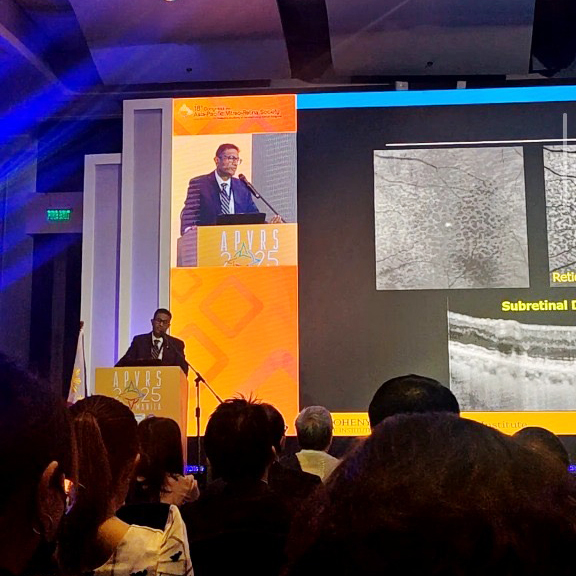
Prof. Sadda, received this honor for his groundbreaking work in retinal imaging, including optical coherence tomography (OCT), OCT angiography and adaptive optics, which revolutionized how ophthalmologists visualize and interpret retinal disease.
READ MORE: Retina Roundup: Your APVRS 2025 Scientific Primer
“OCT really started a revolution in our ability to evaluate the retina providing this kind of retinal biopsy,” he said, highlighting OCT’s disruptive impact.
Prof. Sadda’s lecture emphasized that high-resolution imaging has changed AMD understanding, particularly in distinguishing between neovascular events from true end-stage atrophy. Through OCTA, adaptive optics and high-speed scanning, imaging now provides a detailed understanding that previous generations could only imagine.
The takeaway
From heartfelt leadership messages and vibrant cultural performances to two landmark lectures, APVRS 2025 opened with momentum, warmth and scientific depth. Manila offered not just a venue but a cultural landscape that enriched the congress atmosphere, bridging global science with local identity.
Editor’s Note: This content is intended exclusively for healthcare professionals. It is not intended for the general public. Products or therapies discussed may not be registered or approved in all jurisdictions, including Singapore. Reporting for this story took place during the 18th Congress of the Asia-Pacific Vitreo-Retina Society (APVRS 2025) from 12-14 December in Manila, Philippines.